
40 escenas curiosas del programa de reintroducción del buitre negro en Pirineos filmadas y seleccionadas por Mario (Equipo de Trabajo de Boumort-Alinyà).
{youtubegallery=lo_mejor_de_2012_en_boumort}
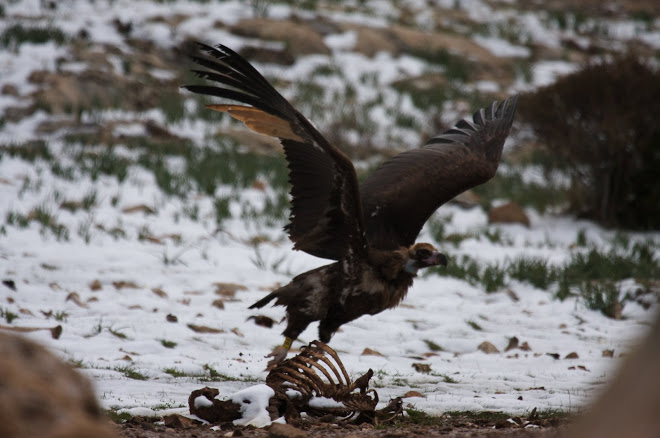
A cinco años de la primera liberación del
Proyecto de Reintroducción de Buitre Negro en Los Pirineos.
Fotos: Marc Galvez. voltornegrepirineus.blogspot.com.es
Five years after the first release of the Project of Reintroduction of Black Vulture in the Pyrenees.
Although five years have passed from the first releases in Alinya and soon after in Boumort, the project started some years before. The first proposal of reintroduction in the prePyrenees of Lleida was done at the beginning of the ninety´s. With this idea of recovering the species in the NorthEast corner of the Peninsula, GREFA tried and did some studies in Aragón, Comunidad Valenciana and Castilla y León, although finally the project started in Cataluña. In the future, it will be very important to develop a similar project in some of the areas studied that could definitely communicate the peninsular populations with the new-born population from the reintroduction project in the Pyrenees and even the French populations. Unfortunately, the unsupportive collaboration from the Autonomous Communities, which was nearly none, on top of non-understandable, could be really bad for this and future reintroduction projects of scavengers in Europe. Communities like Andalucía falsely promised their collaboration since the beginning of the project, but for the moment they have not given a single individual. Is this an example of solidarity or a trick? The exception is Extremadura, that is giving Black vultures for many years for this and other projects in France, and thank to this community the species is recovering. During the last years, Asturias, Valencia and other Communities that do not have the monachus as breeder, are giving some individuals. On top of everything and even though all of the above, the project in the Pyrennes in Cataluña is being very successful, as it can be seen in a little five-year summary written by the “project work team”.
Ernesto Álvarez, President of GREFA
That is why we consider it necessary to offer a faithful report of what has happened so far, displayed in a graphical and concise manner, so that everybody can, just having a look, get a precise picture of what has been achieved. And what is still to be achieved!
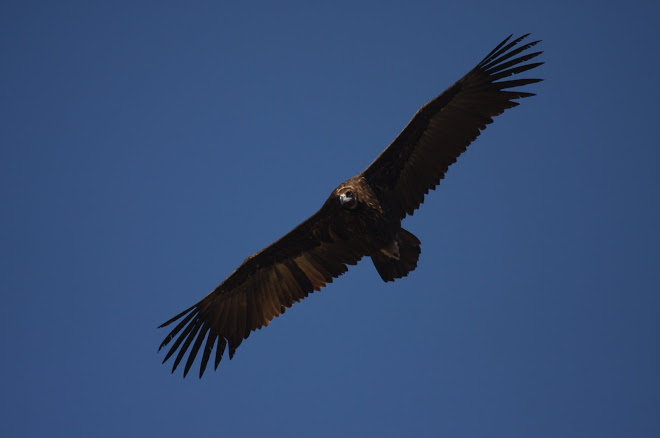
Photos: Marc Galvez. voltornegrepirineus.blogspot.com.es
We can look back on five intense years, as a time trial where the black vultures have broadly demonstrated their ability to function in the same Pyrenean environment they became extinct more than a century ago.
But do not forget that human action has brought them back home, as well as human action threw them out in the past. Because without the effort regarding the rehabilitation, cession, acclimatization, release and daily tracking of the reintroduced individuals, the incandescent image of the four European scavenging species sharing a carcass in these border mountains would remain in limbo.
Or, in the best case scenarios, our great grandchildren would see it.
This is, without a doubt, the first milestone of the project. And there are very few continental local districts that have the privilege –or just the option– of having at the same geographical point in time the Bearded Vulture, the Black Vulture, the Griffon Vulture and the Egyptian Vulture.
 |
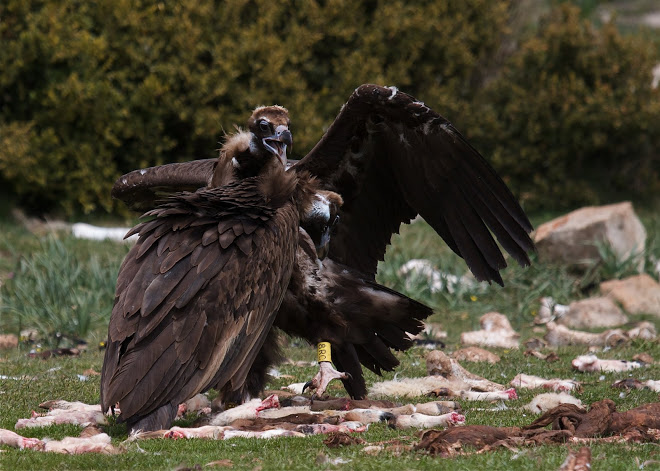 |
In the Lleida Pre-Pyrenees (Catalonia, Spain), thanks to the reintroduction project, there is not only this coincidence but also all the four species breed in the same area.
The second milestone is having got the Black Vulture as a breeding species in the wild in these mountains just 3 years after the release of the first specimens, as well as three fledged chicks.
The third one, to increase in an exponential manner the flow of black vultures through the Pyrenees mountain range, creating a connection between the new French colonies (Cévennes, Baronnies) and the traditional ones from the South West of the Iberian Peninsula.
The fourth one is, thanks to this exchange, having got exogenous individuals settled in this incipient Pyrenean colony.
The fifth one? It would be, no doubt, getting a second generation of individuals born within the colony.
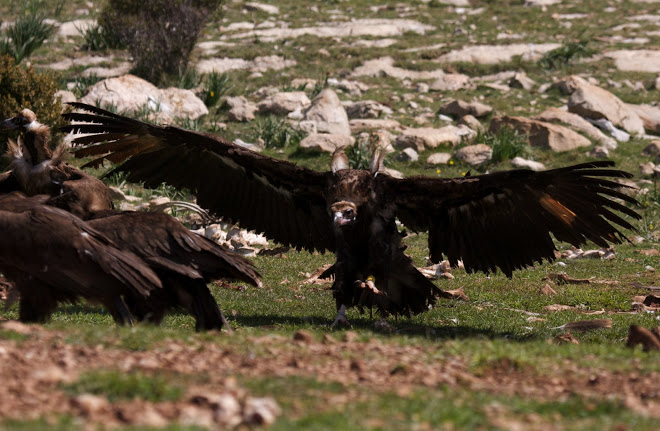
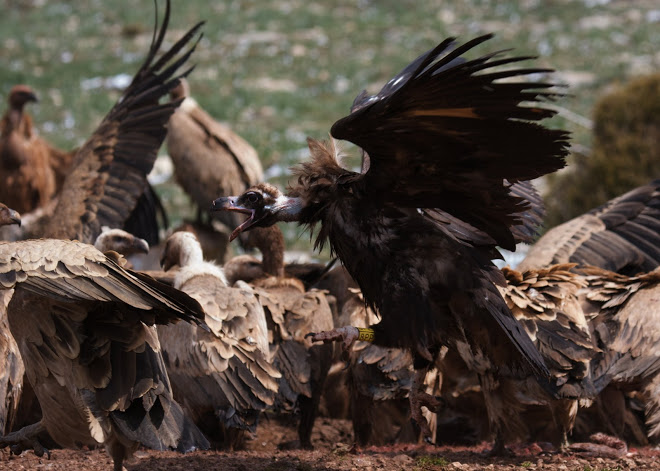
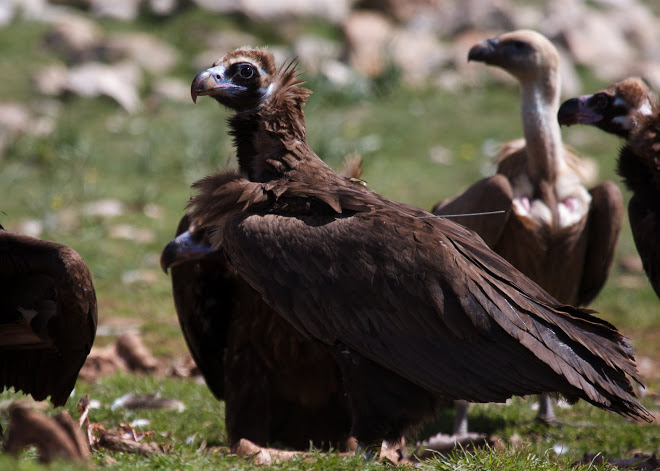
At the end of 2012, the colony has got five pairs of reproductive age and a total of 20 individuals. In the coming years we should double that number if we want to ensure the feasibility of the Pirenean colony, in the mid- and long-term. What is the main obstacle to make this happen? The lack of sufficient donated black vultures to be released. This is the bottleneck that has constrained the programme, as the estimated number of 10-12 individuals per year has been reduced to only 6 (38 in all).
 |
 |
 |
What or who, in spite of that constriction, made it posible to get those milestones? First of all, the capacity of the Black Vulture to recolonize its old habitats. Supported by the constancy and the expertise of a group of both public and private entities that, leaving aside their differences, focused their attention on what was crucial: to restore the Black Vulture as a breeding species in the Pyrenees.
This is why, from these few lines, we want to thank to the Generalitat de Catalunya (Catalan Autonomous Government) and the Fundació Catalunya-La Pedrera (Catalunya-La Pedrera Foundation), promoters of the programme. To GREFA and Trenca Associations, that are in charge of the rehabilitation, sanitary control, acclimatization, release, feeding and tracking of the individuals. To REE, whose sponsorship enabled us to mark the black vultures with terrestrial and GPS-satellite transmitters. To the Autonomous Communities of Extremadura, Valencia, Asturias, Castilla-La Mancha and Madrid, for the cession of individuals admitted into Wildlife Rehabilitation Centres (particularly to the W. R. C. of Los Hornos, in Cáceres, which has been the source of 2/3 of all the black vultures). To Modesto and the rangers of the National Hunting Reserve of Boumort, for their constant support in all works. To Víctor, specialist in marking from the MAGRAMA. And to all physical and legal entities that have understood the ecological relevance of this initiative and suported it, in public or in private.
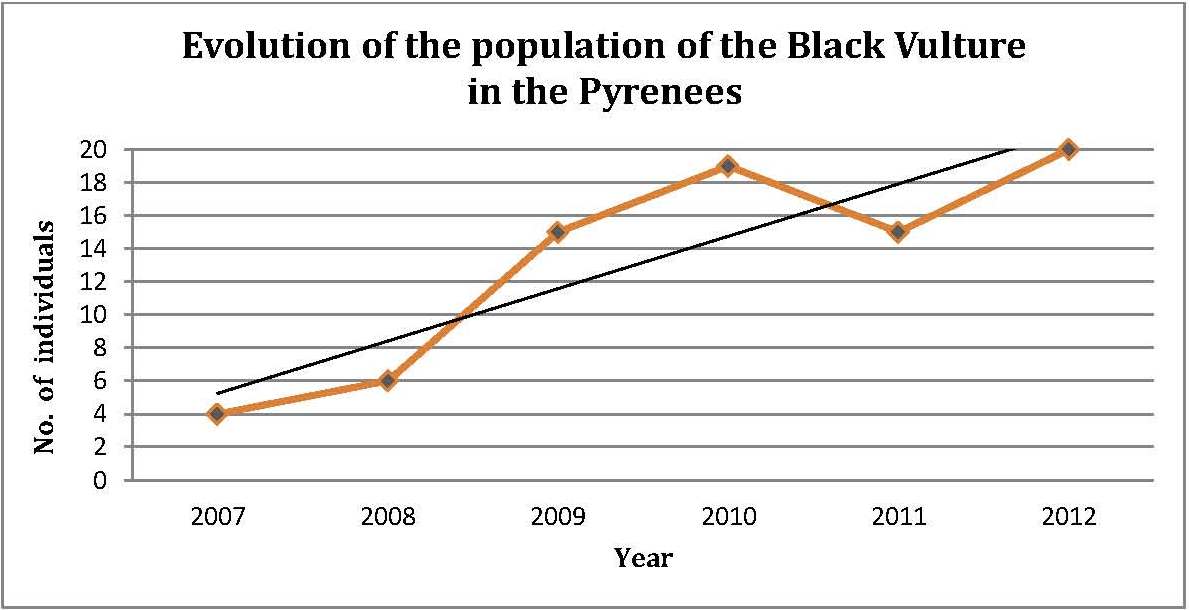
Boumort-Alinyà working team
Han passat cinc anys des dels primers alliberaments d'exemplars. Per això, considerem necessari oferir un balanç fidel al que ha succeït fins a dia d'avui, exposat de manera gràfica i concisa, perquè qualsevol persona pugui, ràpidament, fer-se una idea clara del que s'ha aconseguit. I del que resta per aconseguir!
Han estat cinc anys intensos, com en una contrarellotge en la qual els voltors negres han demostrat sobradament la seva capacitat per adaptar-se en el mateix hàbitat pirinenc del qual van desaparèixer, ja fa més d'un segle.
Fotos: Marc Galvez. voltornegrepirineus.blogspot.com.es
Però no oblidem que ha estat l'acció humana que els ha retornat a la seva llar, igual que va ser l'acció humana que els va fer fora en el passat. Així doncs, sense l'esforç de recuperació, cessió, aclimatació, alliberament i seguiment diari dels exemplars reintroduïts, la imatge incandescent de les quatre espècies d'aus necròfagues europees compartint l'aliment en aquestes muntanyes frontereres hauria quedat relegada als llimbs.
O, en el millor dels casos, ho haguessin contemplat els nostres rebesnéts.
Aquesta és, sens dubte, la primera fita aconseguida pel projecte. I són poques les comarques continentals que tenen el privilegi de tenir l'opció de veure coincidir en un mateix punt geogràfic i temporal el trencalòs, voltor negre, voltor comú i l'aufrany.
|
|
Al Prepirineu de Lleida, gràcies a aquest projecte de reintroducció, no solament es produeix aquesta coincidència puntual, sinó que les quatre espècies es reprodueixen i comparteixen el mateix espai.
La segona fita és haver aconseguit que el voltor negre es reprodueixi en llibertat dins d'aquestes muntanyes, tot just tres anys després d'haver començat els alliberaments dels primers exemplars, amb tres polls que ja han volat dins de la colònia.
La tercera, que s'incrementi de manera exponencial el flux de voltors negres a través de la serralada pirinenca, comunicant les joves colònies franceses (Cévennes, Baronnies) amb les colònies tradicionals del SW ibèric.
La quarta que, arran d'aquest intercanvi, s'hagin fixat en l'incipient nucli pirinenc exemplars exògens.
¿La cinquena? Seria, sense cap dubte, aconseguir una segona generació d'exemplars nascuts dins de la colònia.
|
|
|
En finalitzar el 2012, aquesta compta ja amb cinc parelles en edat reproductora i un total de 20 exemplars. En els propers anys s'haurien de duplicar aquestes dades, si volem assegurar la viabilitat del nucli pirinenc, a mig i llarg termini. Quin és el principal fre per aconseguir-ho? El nombre insuficient dels voltors negres cedits per aclimatar i alliberar a l'àrea de reintroducció. Aquest ha estat el problema que ha frenat el programa, ja que les previsions inicials eren disposar d'entre 10-12 exemplars anuals que han quedat reduïts a 6 (38 del total).
Què o qui ha fet possible que, a pesar de la baixa disponibilitat de voltors negres, s'hagin aconseguit aquests resultats? D’una banda, la capacitat natural d'una espècie com el voltor negre per recolonitzar antigues àrees de distribució. I, d’una altra, la constància i el saber fer d'una sèrie d'entitats públiques i privades que, deixant a un costat les seves discrepàncies, s'han centrat en el més important, que era i és, recuperar el voltor negre com a espècie nidificant al Pirineu.
Per això, volem donar les gràcies a la Generalitat de Catalunya i a la Fundació Catalunya-La Pedrera, promotors del programa. A GREFA i Trenca, entitats encarregades de la recuperació, control sanitari, aclimatació, alliberament, alimentació i seguiment dels exemplars. A REE, pel seu patrocini que ha permès el marcatge amb emissors terrestres i satelitals-GPS. A les C.C.A.A. d'Extremadura, València, Astúries, Castella-la Manxa i Madrid per la cessió d'exemplars ingressats en centres de recuperació (en especial al CR de los Hornos, Cáceres, origen de les 2/3 parts dels exemplars). A Modesto i la brigada de la RNC de Boumort, pel seu suport en les diverses tasques realitzades. A Víctor, especialista en marcatges del MAGRAMA i a totes les persones físiques i jurídiques que han entès la importància ecològica d'aquesta iniciativa i li han donat suport, en públic o en privat.
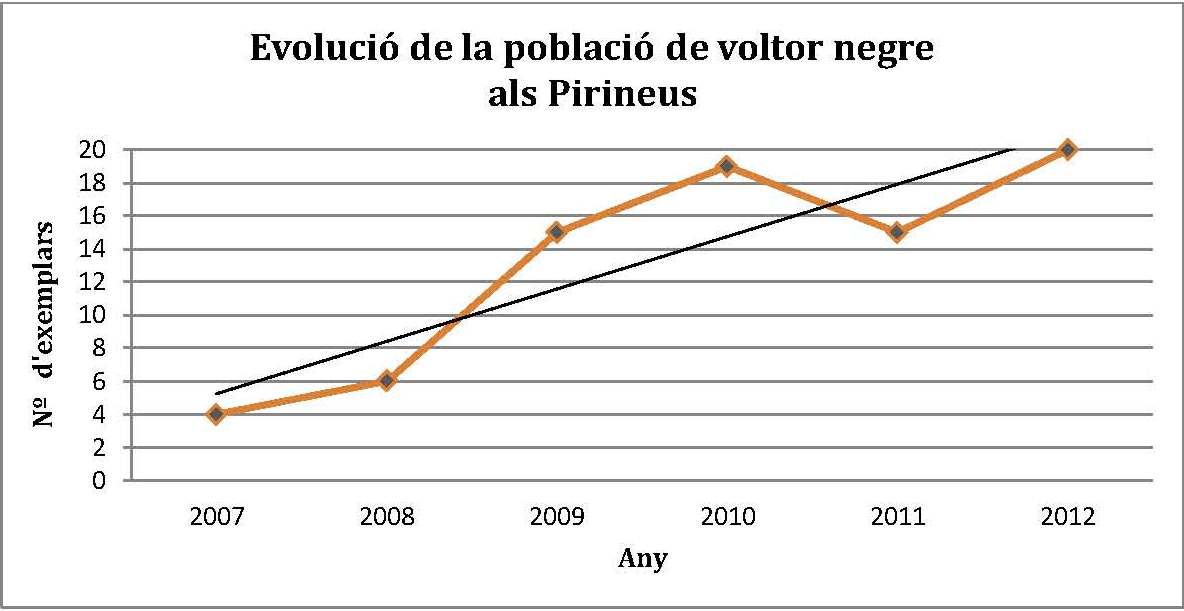
Equip de treball de Boumort-Alinyà
 A través de esta iniciativa plurianual y coparticipada por diversas entidades, se liberan buitres negros procedentes de Centros de Recuperación españoles (Los Hornos y GREFA, principalmente) en dos áreas del Prepirineo de Lleida seleccionadas por su idoneidad.
Actualmente hay asentados en la zona de reintroducción más de veinte ejemplares. Se han formado cinco parejas y en 2010 ha tenido lugar la primera reproducción constatada de la especie en el macizo pirenaico desde hacía más de un siglo.
El espacio geográfico de Boumort-Alinyà se ha convertido en cabeza de puente para la comunicación genética entre poblaciones aisladas. Y, gracias a este proyecto, es además la única región europea donde nidifican las cuatro especies de buitres continentales: quebrantahuesos, buitre negro, buitre leonado y alimoche.


{flike}
Página 1 de 2